Experience
What I've built and where.
Ciel
Flagship
AI Architect & Sole Engineer · Independent project · 2026 - Present
A hyperagent that evolves its own multi-agent interview committee. I designed and
built the entire system: the reasoning core, the ML evolution loop, real-time browser
voice, the backend, and the web app.
Ciel
FlagshipAI Architect & Sole Engineer · Independent project · 2026 - Present
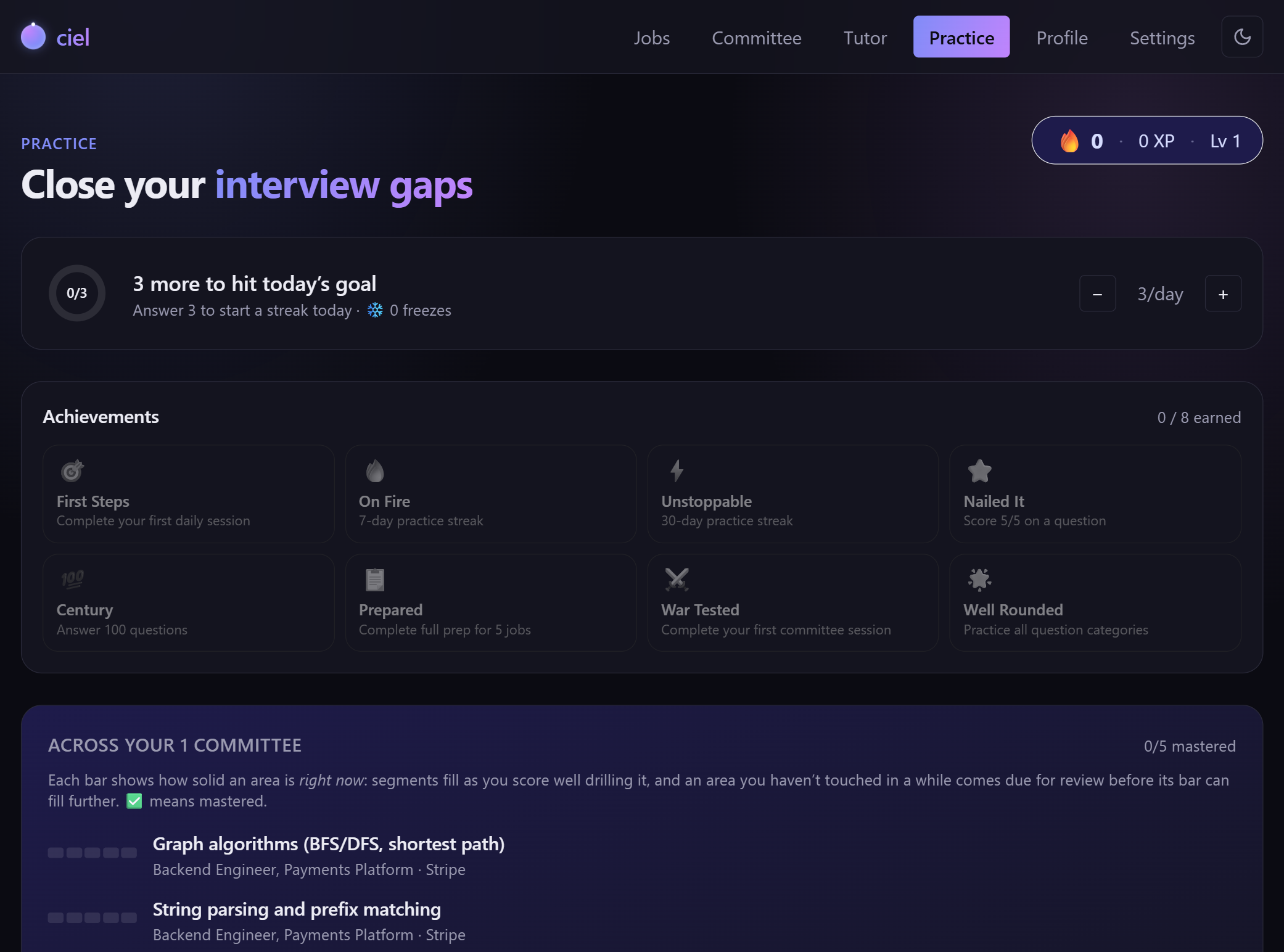
Ciel runs the whole interview-prep loop itself. You search a live role or paste a job description; it builds the interview from the company's real hiring process, runs multi-round mock interviews with a committee of AI interviewer agents by voice, text, or code, and scores every answer. Then it acts on the scores: an AI tutor writes a lesson for your weakest measured area, teaches it out loud taking spoken questions, and re-interviews you on that exact gap to show the before and after delta. A voice concierge drives the app itself: say "interview me" and it navigates, prefills, and starts the round. Above the committee sits a hyperagent, a meta-agent that rewrites the interviewers' own questioning and scoring strategy across generations, and even rewrites how it improves. And it runs a full interview at roughly a tenth of the cost of commercial AI interview tools, which is the whole point: the same depth, a fraction of the cost.
A peek inside
Senior Engineer · asks
"Walk me through how you'd keep one noisy tenant from starving the rest."
then you answer out loud
every round scored on structure, depth, and communication, with targeted feedback.
Generation 3 · fitness climbing
the committee re-tunes its own interviewing and scoring across generations.
7-day streak · 3 cards due today
weak spots become a daily, spaced-repetition review.
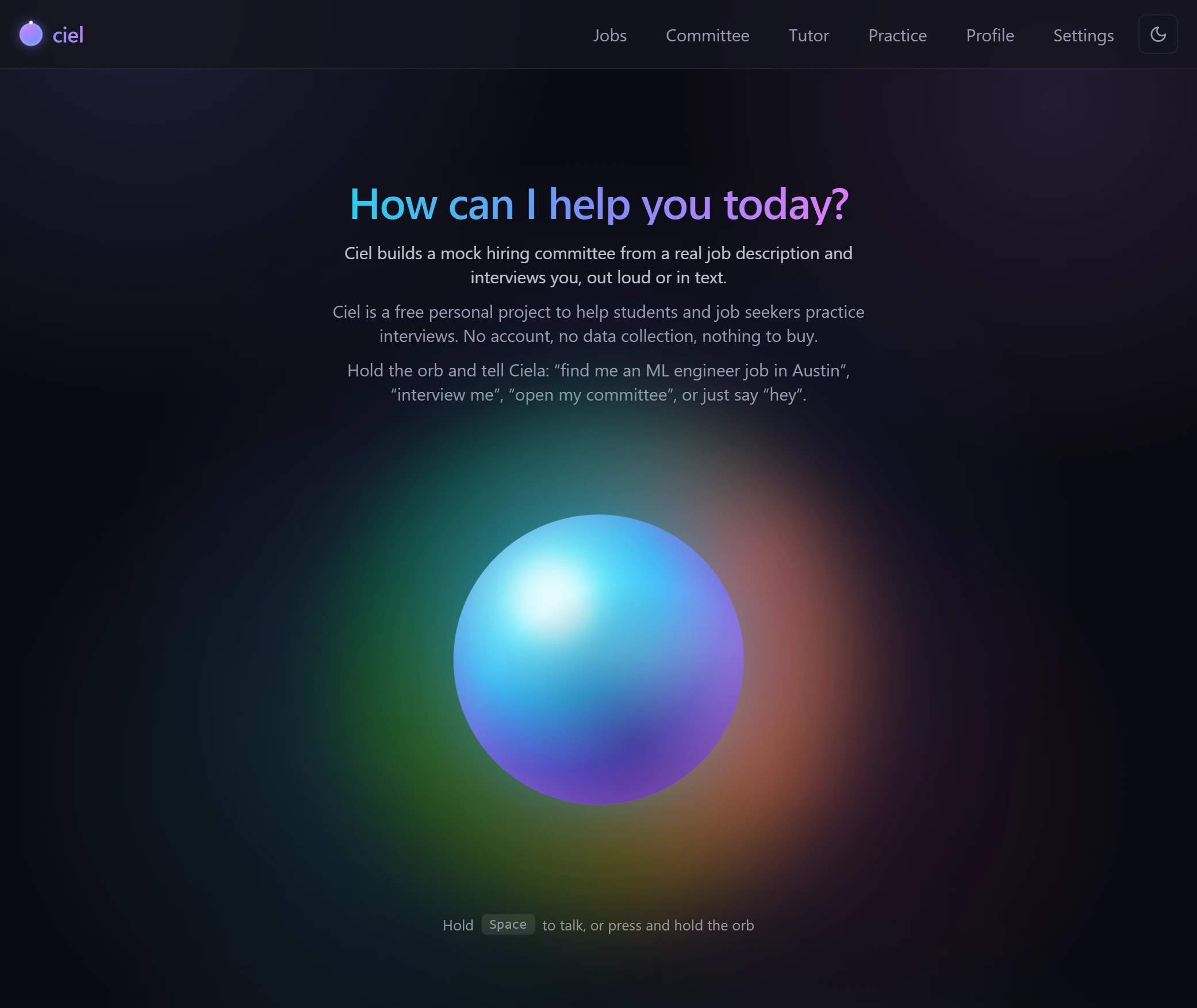
The voice concierge
The committee
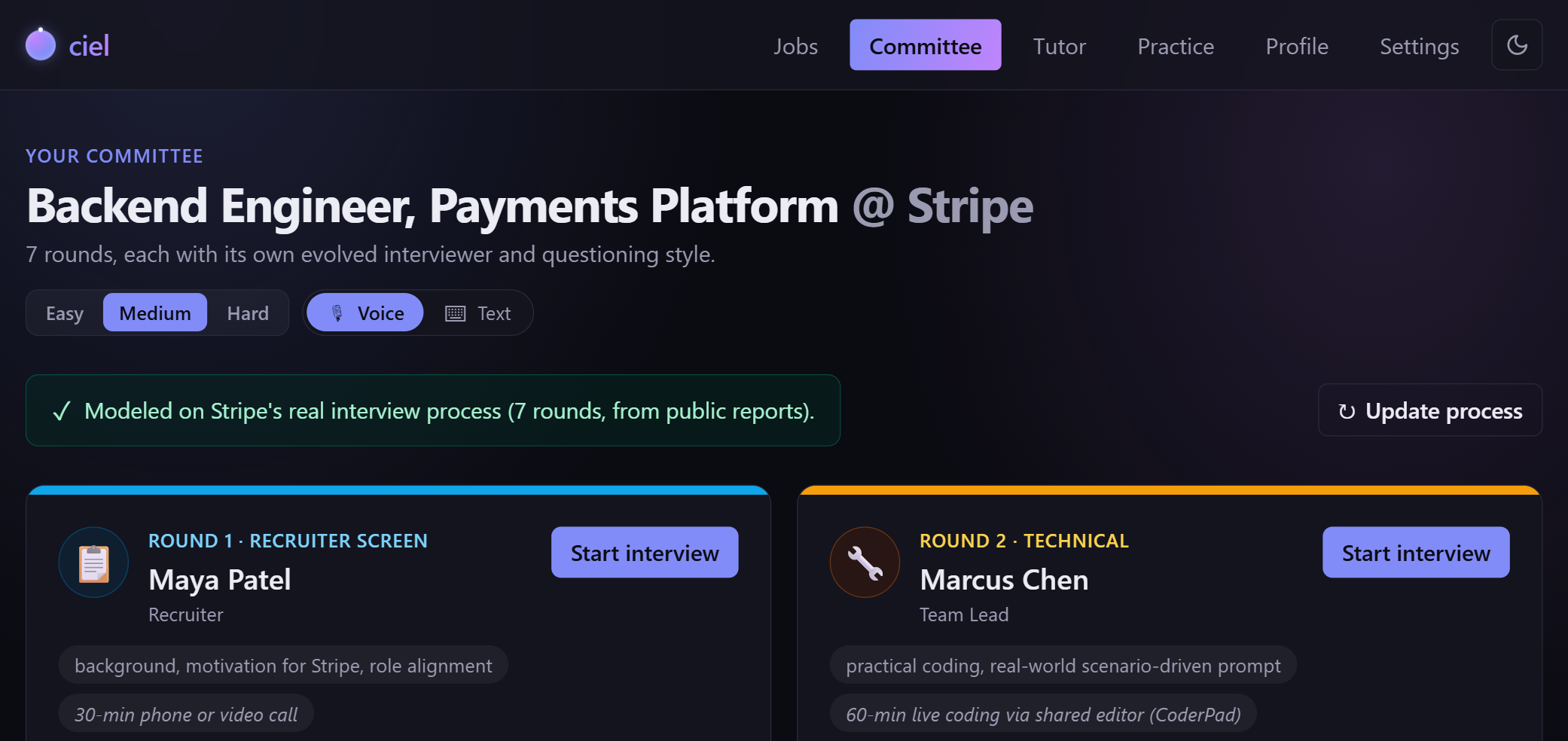
Multi-agent committee
A committee of LLM interviewer agents, each with its own persona, focus, and questioning style, coordinated into one realistic, stateful interview.
Hyperagent self-evolution
A meta-agent rewrites the committee's questioning and scoring strategy across generations, and can revise how it improves: improving the improver. The loop is built to learn from human preference signals, and was validated to get measurably better with zero human feedback, from synthetic preference signals alone.
Dynamic interview process
The rounds are built from the company's real hiring pipeline, and can fold in your own first-hand notes. Not a fixed template.
Autonomous company research
An agent plans its own searches, reads the results, decides what it still needs, and repeats, then writes a focused company prep dossier.
Real-time voice
Interview out loud in real time, with neural voice-activity detection, natural barge-in, and human-like turn-taking, so you practice by talking.
Live coding round
Technical rounds open a real in-browser code editor (Python, JS, TS, Java, C++) whose solution the interviewer reads and reacts to.
Ciela, the voice concierge
A push-to-talk concierge that operates the whole app on command: say "interview me" or "find me an ML job in Austin" and it navigates, prefills, and starts the round itself.
A tutor that closes the loop
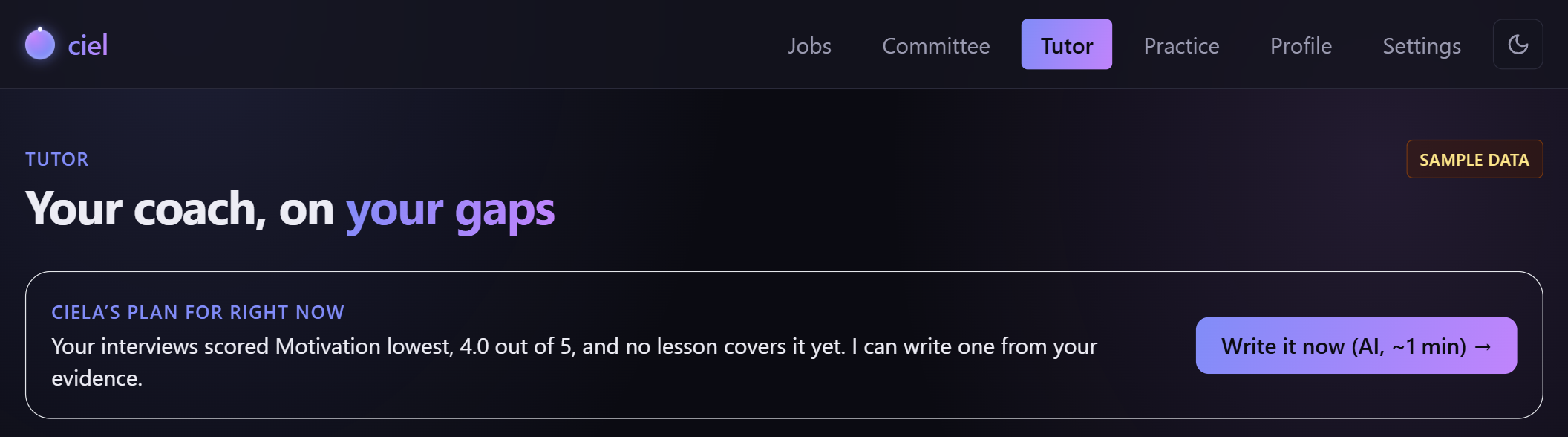
Reads your round scores, picks a lesson for your weakest measured area, writes one when none covers it, teaches it out loud with spoken Q&A, then re-interviews you on that gap and shows the delta.
Course mode, a teaching-first edition
One build-time site mode turns the same codebase into a teaching-first edition of Ciel: lessons with typeset math, a coach that hints before it answers, and tests graded on the device. Built, not public.
The tutor, on your measured gaps
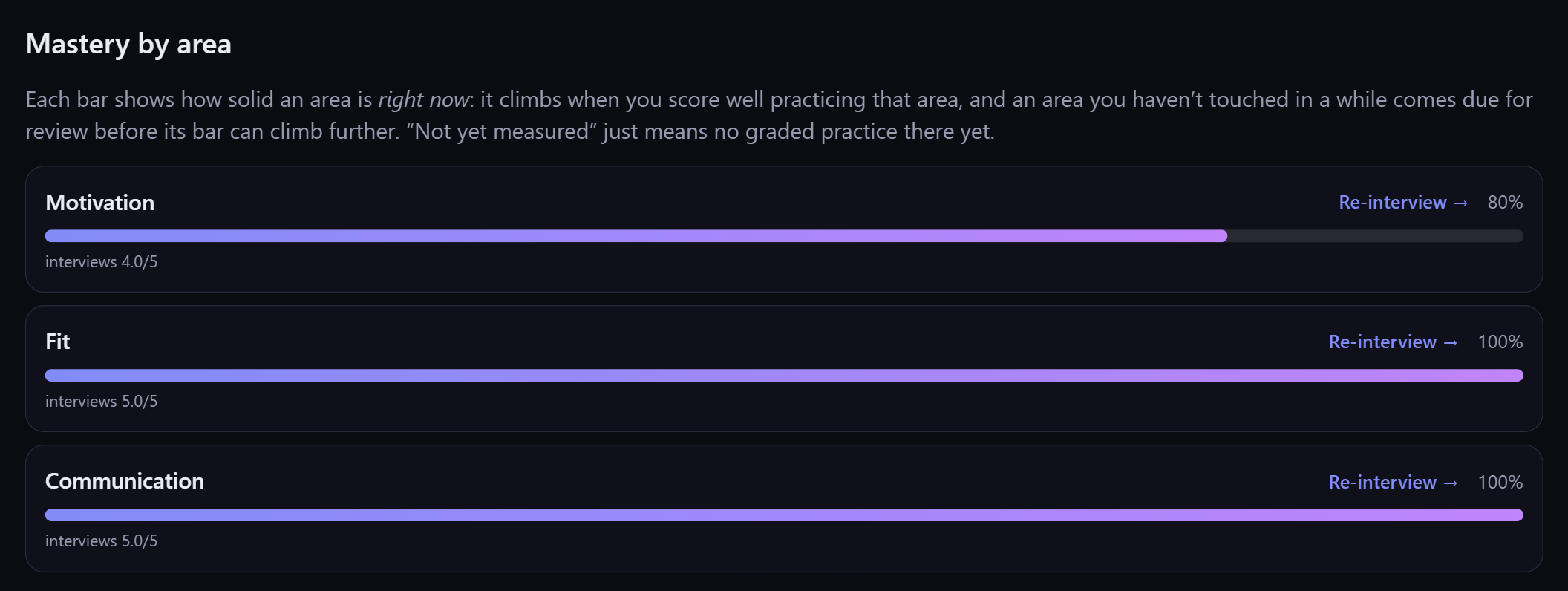
The daily practice loop
Course mode
One codebase, two editions: a single build-time site mode turns Ciel into a teaching-first edition, and build audits confirm the public build carries none of it. Lessons render typeset math. Two computer-vision lessons I directed, on Sobel and Canny edges and on Harris corners, compute every figure and number with dependency-free, from-scratch scripts, and include a keyboard-accessible convolution widget. The lesson coach quotes the learner's wrong step back, gives a hint before the answer, and cites only the lesson's own sources. "Test me" question sets are tagged by Bloom level and graded on the device with no model call, timed or untimed, with Why, Fix and Next reports. Where no lesson covers a weak area, a validated lesson writer drafts one and marks it unreviewed. Course mode is built and kept off the public site.
At a glance
How it's built
Agent orchestration. A panel of LLM agents composed from a company's real, multi-round process, each with its own role, focus, and questioning behavior, coordinated into one coherent, stateful interview.
Real-time browser voice. A browser-native speech cascade with neural voice-activity detection and barge-in, engineered for natural turn-taking and graceful behavior in noisy, no-headphone setups.
Self-improving evaluation. A closed loop re-tunes the interviewing and scoring strategy across generations and is checked on held-out labels it never trains on: a non-circular benchmark that measures how well it separates strong answers from weak ones.
Full-stack ownership. A typed monorepo across reasoning core, web app, and backend, with a large automated test suite and CI-style gates (typecheck, test, build) on every change.
The hard part. The core is the self-improvement loop: a hyperagent that mutates and re-scores its own interviewers, with a train/validation split and a held-out discrimination benchmark it is never allowed to see, so gains are real and not self-flattering. The claim is earned the boring way: replicated runs, a noise-floor control, and an ablation that shows which part of the loop actually produces the gains.
The evidence. The loop is built to learn from human preference signals, and was validated even with zero human feedback: driven purely by synthetic preference signals, it gained +0.15 for one interviewer role on a human-verified held-out benchmark, replicated at +0.19, with a controlled ablation isolating the mechanism responsible. Its strongest single run (one of three on an open-weight model) gained 2.5x the measured noise floor, with the judge's ability to rank strong against weak answers rising from 85% to 100%.
Typed monorepo, a large automated test suite, and CI-style typecheck, test, and build gates on every change. Closed-source; a guided code walkthrough is available on request.
yapbook
Live
Creator & Sole Engineer · Independent project · 2026
An audiobook you can talk to: it reads your own book, paper or PDF aloud and answers
spoken questions only from what you have heard so far. 0 of 72 spoiler verdicts in a
blind benchmark, against 56 of 72 for the same model given the whole book.
yapbook
LiveCreator & Sole Engineer · Independent project · 2026
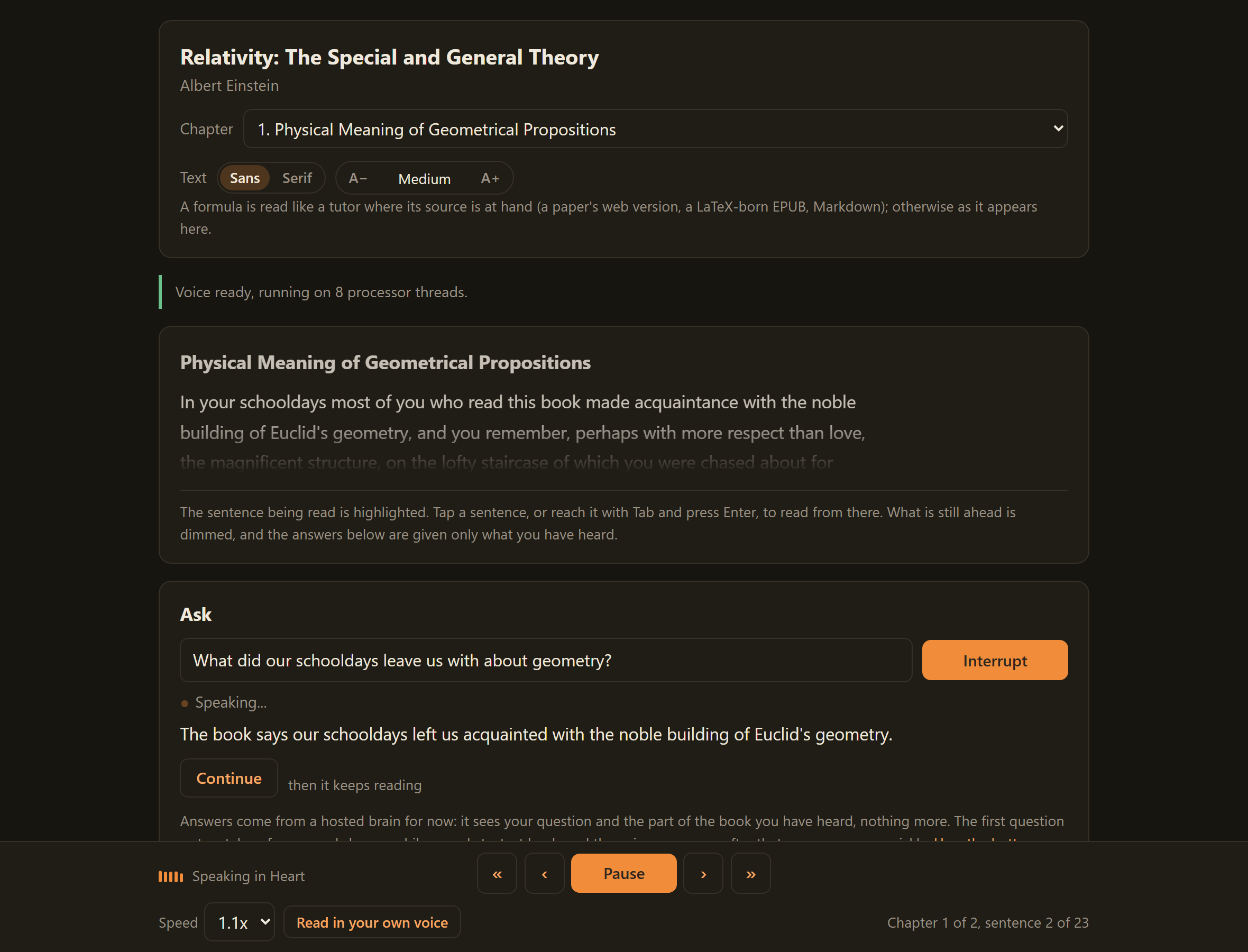
yapbook is a free personal project, live at yapbook.app for laptop and desktop browsers. Drop in a book, paper or PDF, press play, and ask a question out loud whenever a term loses you. The answer comes only from what you have heard so far, so it won't spoil what is ahead, and then the book picks up where it stopped. That is the gap it fills: tools that chat with a PDF see the whole document, so they explain chapter 9 while you are still in chapter 3. Narration, speech recognition and an optional narrator in your own voice run in the browser; when you ask a question, only the question and the part you have heard reach a hosted model. No account, no analytics. I built it alone, for listening to dense textbooks while my hands are busy.
At a glance
How it's built
Position-grounded answering. Answers use only the part of the book already heard. When the answer lies ahead it says the book has not covered that yet, and when part of it was heard it gives that part first.
A public, checkable benchmark. 60 position-pinned questions in 6 books, with gold answers and mechanically verified spoiler facts, graded blind by two judge models. The records are public, one command recomputes the tables, and every change to the answering model is checked on it before it ships.
On-device speech. Neural narration on WebGPU at about 9x real time, with a WebAssembly fallback, and speech recognition that got 27 of 27 words of a 9-second clip in about 0.6 s, both in Web Workers, measured on a high-end laptop.
Your own voice, by consent. Three spoken sentences, the first of them the consent, make a narrator in the reader's own voice inside the browser. The recording is never uploaded, and streamed playback cut tap-to-sound from up to 7.3 s to about 0.5 s on a high-end laptop.
Hands-free from earbuds. One press asks, two skip a sentence, three go back, in Chrome and Edge. It works because the page holds the browser's media session through the silent pauses in narration.
Safari 26, root-caused. Narration was silent only on a real Mac. A self-measuring sound-check page named two faults, one inside a third-party speech library and one in how a Worker loaded its code. Both were fixed, and the library fix was reused in Ciel.
A hardened serverless backend. A few serverless functions call the one hosted model, with per-address rate limits, same-origin checks and the key only on the server. The page fetcher checks every redirect against private address ranges, and nothing you read or ask is stored by the site.
A private desktop edition. A fully local edition in Python answers from a local model in 1.9 s median from question end to first answer audio on a high-end laptop, and its MCP server lets coding agents add, ask about and play books.
The hard part. Proving the one claim: that the answers stop where you are. As first deployed, the benchmark showed 66 of 72 spoiler-free verdicts and 36 of 48 honest ones; all six spoiler verdicts were a hosted model finishing textbook questions from memory. I added an answer-verification guard and ran five hosted models through the benchmark. Three went on to full blind judging, and I chose the only one at 72 of 72 spoiler-free and 48 of 48 honest, which was also the fastest of the three at a 1.2 s median latency. I re-measured the live site the same night at 72 of 72 and 48 of 48.
Where the numbers come from. The At a glance figures are from a later run of the deployed code and model behind a local port: still no spoiler in 72 verdicts, and 46 of 48 honest ones, where the two verdicts that moved gave only the part already heard, without a spoiler. The 72 verdicts are two judges on the 36 questions whose answer lies ahead of the listener, wholly or partly; the 48 are two judges on the 24 whose answer lies wholly ahead. The limits are stated with the records: one run per cell, LLM judges, typed questions.
It also keeps bookmarks by voice, quizzes you out loud at the end of a chapter if you ask, brings your own questions back on a spaced schedule, and reads a formula aloud like a tutor where its source is at hand.
Closed-source. The benchmark records are public under CC BY 4.0, with the grading scripts under Apache-2.0.
claude-crusts
Open source
Creator & Maintainer · npm package · 2026
A published open-source CLI that analyzes Claude Code context windows to find wasted
tokens and generate fixes. 80+★ on GitHub, 1,900+ npm downloads.
claude-crusts
Open sourceCreator & Maintainer · npm package · 2026
A command-line tool I designed, built, and maintain. It inspects a Claude Code context window, identifies where tokens are being wasted, and generates actionable fix commands. It runs fully offline with zero API calls, which keeps it fast and private. Published to npm and adopted by developers in the wild.
Senior Software Engineer
HCLTech America · Sacramento, CA · Jun 2024 - Present
Production AI for NVMe semiconductor test data: an LLM analysis system, an MCP-enabled investigation agent, ML forecasting and anomaly detection, and the full-stack tooling around them.
Senior Software Engineer
HCLTech America · Sacramento, CA · Jun 2024 - Present
LLM-powered analysis system for NVMe semiconductor test data
- Architected an LLM analysis system that combines millions of test records with thousands of chunked specification documents, using prompt engineering and domain-adapted fine-tuning (LoRA/QLoRA) to automate narrative generation: grounded summaries, anomaly findings, and conformance reports. It reached 90% output quality, scored by test engineers, and cut manual analysis from hours to ~6 minutes.
- Built a 3-layer hybrid retrieval architecture combining SQL precision queries, OpenSearch BM25 sparse retrieval, and dense k-NN semantic search with Reciprocal Rank Fusion (RRF), improving specification Recall@5 from 80% to 88% across 100 labeled queries.
- Deployed an MCP-enabled NVMe investigation agent that integrates Snowflake diagnostics, OpenSearch retrieval, and deterministic conformance validation, reaching 86% evidence-supported investigation accuracy across 50 labeled anomaly cases, with bounded tool execution and failure recovery.
- Engineered an LLM guardrails, evaluation, and observability layer with hallucination detection, automated quality scoring, deterministic numerical validation, and evidence-grounding checks, reaching 95% numerical accuracy and resolving a critical 1,000× unit-conversion defect.
- Engineered automated LLM provider routing with error-driven failover across Dataiku and OpenAI endpoints, eliminating manual switching during report generation.
ML-driven dashboard for failure forecasting and anomaly detection
- Built failure forecasting, anomaly detection, and root-cause insights for testers.
- Created an ARIMA-based hybrid model with Python UDFs in Snowpark ML for time-series forecasting at 84% accuracy.
- Enhanced anomaly detection with autoencoder-based UDFs that flag outliers across 2.5 million daily NVMe test entries, with integrated root-cause diagnostics.
Internal tester dashboard, full-stack (Flask + D3.js)
- Resolved browser crashes from 200MB+ bulk data loads by redesigning the dashboard's Snowflake data access around on-demand queries, cutting page load from 20+ minutes to under 10 seconds.
- Built a FastAPI + Streamlit clustering tool with Snowflake-backed pattern tables, deep-linked navigation, auto-zoom drill-down modals, and CI/CD, backed by an automated test suite and used by teams to pre-screen issues before debugging.
Software Engineer
Danlaw Inc · Novi, MI · Mar 2023 - May 2024
Computer-vision and ML for driver safety: drowsiness detection and radar-based vehicle trajectory prediction.
Software Engineer
Danlaw Inc · Novi, MI · Mar 2023 - May 2024
Driver drowsiness detection
- Built an enhanced drowsiness detection system with a hybrid metric fusing Eye Aspect Ratio (EAR), PERCLOS, and Gaze score; used GANs for face synthesis and GPT-3 to refine feature extraction, for an 18% accuracy gain.
Multi-step vehicle trajectory prediction (radar)
- Designed an algorithm fusing an Unscented Kalman Filter (UKF) with a Spatio-Temporal Graph Convolutional Network (ST-GCN) to predict on-road vehicle trajectories from radar sensor data, improving prediction accuracy 16% over the Kalman-filter-only baseline through time-series analysis and sensor fusion.
Research Assistant
University at Buffalo · Buffalo, NY · Sep 2022 - Jan 2023
Research engineering on web-scraping and text-analysis tooling for large-scale data acquisition.
Research Assistant
University at Buffalo · Buffalo, NY · Sep 2022 - Jan 2023
Web-scraping and data-extraction tools
- Built a Google Patent parsing tool with the BeautifulSoup Python package to extract structured data from HTML.
- Used Selenium WebDriver to scrape sites with dynamic, JavaScript-rendered content.
- Implemented text-inconsistency detection software.
Machine Learning Engineer
CIET · Feminist Pen Foundation · Remote · Jan 2021 - Jun 2022
Built TraceX, an NLP SaaS for COVID-19 infection control, plus NLP models for risk estimation and cyberbullying detection.
Machine Learning Engineer
CIET · Feminist Pen Foundation · Remote · Jan 2021 - Jun 2022
TraceX: NLP conversational interface for COVID-19 risk
- Led the design and build of TraceX, an NLP conversational interface integrated with Telegram (400M+ user base) for real-time COVID-19 risk assessments through interactive dialogue.
- Implemented conversational flows in GCP Dialogflow with intent structuring and entity extraction for personalized risk evaluations.
- Fine-tuned an ML information-retrieval model over news articles (precision 0.78, AUC 0.80) to predict infection risk.
Cyberbullying detection (deep learning)
- Designed and trained a hybrid RNN-LSTM network, using BERT for data augmentation and GPT-2 for synthetic data generation, improving accuracy by 2.4%.
Director of Administration
Feminist Pen Foundation · Remote · Aug 2020 - Jun 2022
Led administration, budgets, and HR for a 17-person cross-functional team in an Agile environment.
Director of Administration
Feminist Pen Foundation · Remote · Aug 2020 - Jun 2022
Led administration, budgets, and HR operations across a 17-person cross-functional team in an Agile environment, overseeing departmental resource allocation.